
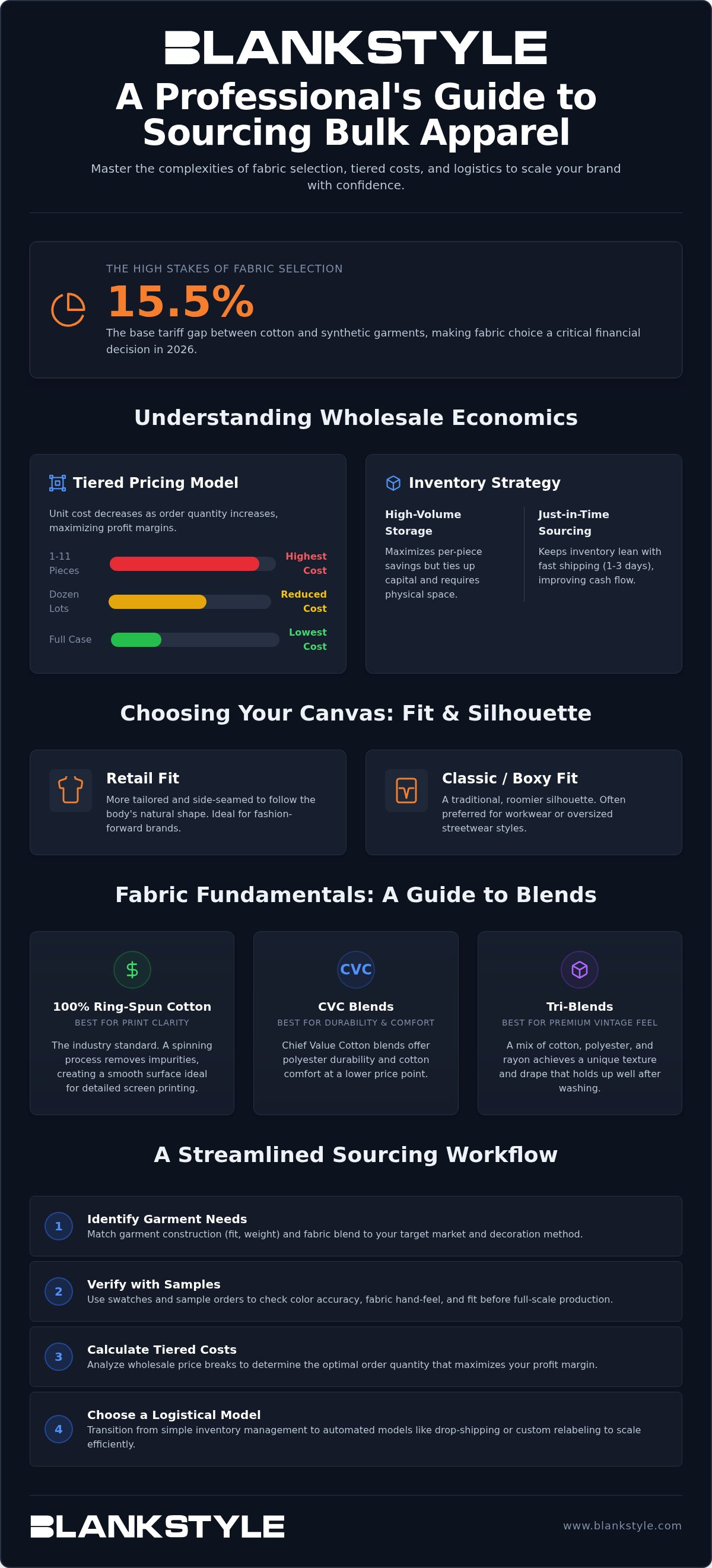
A single percentage point in your fabric blend can be the difference between a profitable quarter and a total loss. In 2026, the 15.5 percentage point base tariff gap between cotton and synthetic garments makes fabric selection a high-stakes financial decision. You’ve likely felt the frustration of inconsistent fabric quality or watched hidden freight fees erode your margins. Sourcing bulk apparel shouldn’t feel like a gamble on technical terms like CVC, GSM, or ring-spun cotton.
It’s time to move past the search for the lowest unit price and adopt a professional framework for your supply chain. This guide provides the tools to master sourcing complexities, ensuring your garments hold up under professional decoration while maintaining predictable pricing models. We’ll examine fabric engineering, tiered cost calculations, and the logistics of modern manufacturing. From navigating new CPSC eFiling requirements to selecting the right heavyweight silhouettes, you’ll gain the technical expertise needed to scale your brand with confidence. This is about building a reliable pipeline that supports your creative and financial goals.
Key Takeaways
- Learn how to calculate tiered costs and navigate wholesale economics when purchasing bulk apparel to maximize your brand’s profit margins.
- Identify the ideal garment construction for your target market by comparing retail fits with structured, heavyweight silhouettes.
- Streamline your production workflow by using swatches and sample orders to verify color accuracy and fabric hand before full-scale production.
- Match specific fabric blends to your chosen decoration method, ensuring optimal ink adhesion for screen printing and proper tension for embroidery.
- Transition from inventory management to automated logistical models like drop-shipping and custom relabeling to scale your operations efficiently.
Defining Bulk Apparel: More Than Just Large Quantities
Bulk apparel refers to blank garments purchased in high volumes for the purpose of secondary decoration or resale. Unlike retail shopping, this process centers on the mechanics of Wholesale fashion distribution. Here, the focus shifts from individual garment aesthetics to unit-cost efficiency and supply chain reliability. These “blanks” serve as the foundational canvas for the custom clothing industry, providing a consistent base for screen printing, embroidery, and brand relabeling.
This sourcing model supports a diverse range of buyers. Retailers use it to stock seasonal collections. Event planners purchase bulk apparel to create unified branding for large-scale gatherings. Private label brands rely on high-quality blanks from manufacturers like Bella+Canvas and Next Level Apparel to build their own lines without the overhead of direct factory manufacturing. Understanding the shift from “price per piece” to “price per dozen” is the first step in professionalizing your procurement process.
The Economics of Tiered Wholesale Pricing
Wholesale pricing is rarely flat. It operates on a tiered structure where the unit cost decreases as the quantity increases. Standard breaks often occur between small individual orders (1-11 pieces), dozen-lot increments, and full-case quantities. This tiered model directly impacts your profit margins. Lowering your cost of goods through volume breaks provides the financial headroom needed for competitive retail pricing. While high volume offers the best value, the ability to order with “no minimums” is a critical strategic feature. It allows you to test a new heavyweight t-shirt or a specific colorway before committing to a full case, reducing the risk of unsold inventory.
Inventory vs. Just-in-Time Sourcing
Managing bulk apparel requires balancing storage overhead against volume discounts. Storing high-volume orders maximizes your per-piece savings but ties up capital in physical floor space. Conversely, a just-in-time sourcing model leverages fast shipping, often delivering in 1 to 3 days, to keep inventory lean. This logistical speed allows you to react to seasonal demand spikes without the burden of long-term storage. Reliable logistics turn your supply chain into a flexible tool. You can maintain lower stock levels while knowing you can replenish wholesale blank t-shirts quickly as orders arrive. This balance is essential for maintaining a healthy cash flow in a fast-moving market.
How to Select the Right Blanks for Your Brand
Selecting a garment for bulk apparel projects requires a clear understanding of the end-user’s lifestyle. A gym-goer needs moisture-wicking durability, while a boutique customer expects the soft hand-feel associated with “Quiet Luxury.” The “Fit” factor is equally critical. Retail fits are typically more tailored and side-seamed to follow the body’s natural shape. Conversely, boxy or classic fits offer a more traditional, roomier silhouette often preferred for workwear or oversized streetwear. Your brand positioning determines whether you source premium labels like Bella+Canvas or value-driven leaders like Gildan. Professional buyers use model numbers rather than generic descriptions to ensure consistency. The Gildan 5000, for instance, provides a specific fit and weight that differs significantly from fashion-forward alternatives. Consumers also prioritize Supply chain transparency, making the choice of manufacturer a key part of your brand story.
Fabric Composition: Cotton, CVC, and Tri-Blends
Fabric choice dictates how a garment feels and how it accepts ink. Choosing the right fabric for bulk apparel ensures the finished product meets professional standards. 100% Ring-spun cotton is the industry standard for print clarity. The spinning process removes impurities, creating a smooth surface ideal for detailed screen printing. CVC (Chief Value Cotton) blends offer a balance of polyester durability and cotton comfort at a lower price point. For premium retail brands, tri-blends provide a unique texture and drape. These garments use a mix of cotton, polyester, and rayon to achieve a vintage feel that holds up well after repeated washing.
Weight and Texture: Understanding GSM and Ounces
Garment weight is measured in ounces per square yard or grams per square meter (GSM). Lightweight fabrics (3-4 oz) are best for summer fashion or layering. They offer high breathability but may show more wear over time. Midweight options (5 oz) serve as the versatile industry standard, balancing cost with a substantial feel suitable for promotional events. In 2026, the trend toward structured silhouettes has increased demand for heavyweight t-shirts (6 oz+). These provide the durability and boxy fit essential for modern streetwear brands. It’s important to match the weight to the intended use to ensure customer satisfaction.
Finding the right balance between cost and quality is easier when you can compare specs side-by-side. You can browse our full collection of wholesale blank t-shirts to find the exact model that fits your project requirements.
A Step-by-Step Guide to Sourcing Bulk Apparel
Success in procurement depends on a structured workflow that moves from initial requirements to final delivery. Establishing your project constraints, specifically quantity, budget, and timeline, prevents logistical bottlenecks later in the process. When sourcing bulk apparel, you aren’t just buying shirts; you’re managing a supply chain. Efficient online ordering requires a clear understanding of your size distribution and color needs to avoid the costs associated with split shipments or backorders. Managing these logistics effectively ensures your project stays on track from the first click to the final delivery.
Step 1: Sampling and Quality Assurance
Skip the guesswork by ordering samples for every new style or fabric blend you consider. This small initial investment allows you to verify the actual hand-feel and fit against manufacturer descriptions. Conduct rigorous internal testing for shrinkage after a standard wash cycle and check for colorfastness to ensure dyes don’t bleed. Printability is also a factor; certain fabrics react differently to heat and ink. If a garment fails these tests, a 60-day return policy provides a safety net to return unused blanks and pivot to a different model without losing your investment.
Step 2: Calculating the Landed Cost
Your margin is determined by the landed cost, not the wholesale unit price. You must account for every variable, including freight charges and decoration fees. Smart sourcing involves hitting specific shipping thresholds, like free shipping on orders over $69, to eliminate one of the most common hidden costs in the industry. To streamline your planning, use an instant quote tool to get immediate visibility into total costs for both blanks and custom services. This transparency allows you to lock in pricing and verify that your project remains within the established budget before production begins.
Step 3: Finalizing the Bulk Order
The final stage requires a deep dive into inventory data. Check real-time stock levels across multiple warehouses to ensure your full size run is available. Size-breakdown planning is essential; most brands follow a “1-2-2-1” ratio for S-M-L-XL, though your specific target market may require more 2XL or 3XL units. Once you’ve confirmed your wholesale blank t-shirts are in stock, verify the estimated shipping lead times. Coordinating these details ensures your goods arrive in time for your launch or event, maintaining your brand’s reputation for professional reliability.
Matching Apparel Blanks to Decoration Methods
Sourcing bulk apparel requires technical alignment between the fabric substrate and your chosen decoration method. The chemistry of ink varies significantly by fabric blend. Plastisol inks sit on top of the fibers, providing vibrant color on most materials, while water-based inks soak into the fabric for a softer hand-feel. Screen printing remains the industry standard for high-volume efficiency, but Direct-to-Garment (DTG) offers a solution for complex, high-color designs on 100% cotton. Specialty items like hoodies and structured hats require specific sourcing strategies to ensure the decoration doesn’t compromise the garment’s fit or structural integrity. Each method has a “winning” blank based on its physical properties.
Best Blanks for Screen Printing
High-stitch density is a prerequisite for fine detail in screen printing. A tighter weave provides a smoother surface, preventing ink from falling between the fibers and creating a blurred image. This is why ring-spun cotton remains the preferred substrate for professional printers. If you’re using discharge printing, 100% cotton is mandatory. This process removes the garment’s original dye and replaces it with a new pigment, a chemical reaction that only occurs with natural fibers. When working with blends, you must manage polyester content to prevent dye migration. This occurs when the garment’s color bleeds into the printed ink during the heat-curing process. Using low-bleed inks or polyester-specific blockers is a necessary logistical step for these bulk apparel orders. For a deeper look at how fabric specifications affect your sourcing decisions, our ultimate guide to sourcing wholesale shirts in 2026 covers CVC blends, ringspun cotton, and tariff considerations in detail.
Sourcing for Embroidery and Specialty Services
Embroidery places physical stress on the fabric through high-speed needle penetration. You must select heavyweight fabrics that can support high stitch counts without puckering or tearing. Sourcing sweatshirts and outerwear with a high GSM ensures the material has the necessary tension to hold the embroidery thread securely. For headwear, structured crowns provide a stable surface for the machine, making them easier to embroider than unstructured alternatives. Professional embroidery services deliver a retail-ready finish that elevates the perceived value of your brand. It’s often more efficient to source blanks and decoration from a single provider to ensure technical compatibility and reduce shipping overhead.
Ensure your designs look their best by choosing the right foundation. You can use our instant quote tool to see how different decoration methods and garment choices impact your final project costs.
Scaling Your Brand with Logistical Solutions
Scaling an apparel brand requires moving from simple procurement to sophisticated logistical management. Once you’ve mastered the selection of bulk apparel, you must optimize how those goods reach your customers. Custom branding, such as tag removal and relabeling, transforms standard blanks into proprietary retail products. Building a resilient supply chain is equally vital. In 2026, regulatory changes like California’s SB 707 and the CPSC’s mandatory eFiling system make compliance a non-negotiable business function. Maintaining backups for your primary brands ensures you can navigate stock shortages or trade policy shifts without interrupting your sales cycle.
Leveraging Drop-Shipping for Growth
Traditional inventory models require significant capital for physical storage. You can eliminate this overhead by utilizing drop shipping solutions. This model allows you to scale your product line without increasing physical inventory. Success here depends on managing customer expectations with reliable shipping timelines. By outsourcing the logistics of storage and fulfillment, you focus on marketing and design while your partner handles the distribution. It’s an efficient way to expand without the financial risk of unsold stock.
Expanding into New Categories
Diversification reduces market risk and increases average order value. Use your established bulk apparel pipeline to test trending silhouettes like crop tops. Adding accessories such as bags provides a low-risk way to expand your brand’s footprint. Sourcing kids t-shirts enables family-oriented branding, opening new demographic segments. This iterative approach to category expansion allows for data-driven growth without massive upfront investments.
The future of the industry is defined by traceability and environmental responsibility. As of July 1, 2026, California’s SB 707 requires an Extended Producer Responsibility framework for textile recycling. Compliance with the Uyghur Forced Labor Prevention Act (UFLPA) is also mandatory. You must provide documentation that traces your supply chain back to raw materials. Sourcing sustainable fabrics is no longer just a marketing choice; it’s a regulatory requirement for brands operating at scale. Ethical sourcing practices protect your brand’s reputation and ensure long-term viability in a tightening regulatory environment.
Professionalizing Your Apparel Procurement
Success in the 2026 market requires moving beyond simple transactions. Professional sourcing of bulk apparel centers on technical fabric selection and a deep understanding of landed cost economics. You now have the framework to navigate new trade tariffs and compliance regulations while maintaining your margins. By matching high-quality blanks with the correct decoration methods, you ensure your finished products meet retail-ready standards. This strategic approach turns your supply chain into a competitive advantage.
Scaling your brand depends on logistical reliability and consistent quality. Whether you’re testing new silhouettes or integrating drop-shipping models, having a stable partner is critical. It’s about more than just buying shirts; it’s about building a resilient pipeline that supports your creative and financial goals. We’re here to help you manage these complexities with ease and professional efficiency.
Take the next step in your sourcing journey. Shop Bulk Apparel and Blanks at Blankstyle to benefit from tiered volume discounts applied automatically and free shipping on orders over $69. Our team is ready to support your projects with professional screen printing and embroidery services designed for high-volume success.
Frequently Asked Questions
What is the difference between wholesale and bulk apparel?
Wholesale is the business model focused on B2B distribution and tiered pricing. Bulk apparel refers to the physical quantity purchased in a single transaction. While the terms are often used interchangeably, wholesale describes the relationship between the supplier and the buyer. Bulk refers specifically to the volume thresholds that trigger lower unit costs. At Blankstyle, we combine both by offering a wide selection of brands with pricing that scales based on your order size.
How do I get the lowest price when buying t-shirts in bulk?
To get the lowest price, you should purchase in full-case quantities and take advantage of tiered pricing structures. Discounts are applied automatically as your volume increases, typically at dozen and case breaks. You should also ensure your order total exceeds $69 to qualify for free shipping. Consolidating your purchases into fewer, larger shipments maximizes your margins by reducing the per-unit freight cost and accessing the most aggressive wholesale shirts pricing available for your project.
Can I mix and match sizes and colors in a bulk order?
Yes, you can mix and match different sizes and colors within your order. This flexibility is essential for brands that need to maintain a full size run without overstocking a single SKU. While you can combine items, keep in mind that tiered discounts are often based on the quantity of a specific style. This approach allows you to test new colorways or silhouettes while still benefiting from the logistical efficiency of a larger combined shipment.
Do I need a resale license to buy bulk apparel?
You don’t need a resale license to buy from us, but it’s beneficial for tax purposes. If you provide a valid resale certificate, you won’t be charged sales tax on your orders. This is a standard practice for businesses that resell garments or provide custom decoration services. For those starting out, you can still purchase bulk apparel without a license, though you’ll pay the applicable sales tax for your shipping destination at the time of purchase.
What are the best brands for high-quality blank shirts?
The best brands depend on your specific requirements for fit, weight, and price point. Bella+Canvas and Next Level Apparel are the standard for premium, retail-fit garments with a soft hand-feel. For value-driven projects or event merchandise, Gildan remains a reliable choice due to its durability and extensive color range. If you’re targeting the streetwear market, heavyweight t-shirts from brands like Shaka Wear offer the structured, high-GSM silhouettes that are currently in high demand.
How does shipping work for heavy bulk orders?
Shipping for large orders is handled through our national distribution network to minimize transit times. We provide free shipping on all orders over $69, which significantly lowers the landed cost of your goods. Most shipments arrive within 1 to 3 days, allowing you to maintain leaner stock levels. This efficient logistics system ensures that even heavy, high-volume orders are delivered quickly and affordably across the country without the need for complex freight arrangements or hidden fees. Our bulk apparel logistics are designed for maximum speed.
What is the return policy for wholesale blank clothing?
We offer a 60-day return policy for unused and undecorated blank clothing. This window gives you enough time to verify the fabric quality, color accuracy, and fit of your order. Remember that garments cannot be returned once they’ve undergone secondary decoration like screen printing or embroidery. This policy provides a critical safety net for brands, allowing you to sample and test new styles with minimal financial risk before committing to full-scale production.
How do I know if a shirt is good for screen printing?
A shirt is ideal for screen printing if it has a high stitch density and a smooth, flat surface. 100% ring-spun cotton is the gold standard because the spinning process removes impurities, creating a better bond with the ink. If you’re using discharge printing, you must use 100% natural fibers. For blended fabrics, ensure you use low-bleed inks to prevent dye migration, which is where the garment’s color bleeds into the print during the heat-curing process.