
High-performance apparel decoration isn’t just about the ink. It’s the final link in a technical chain that begins with fabric selection and ends with logistical precision. To stay competitive, brands must leverage professional custom screen printing services that prioritize consistency across every unit. With the industrial screen printing market projected to reach 1.0143 billion dollars in 2026, the competition for retail shelf space is tighter than ever. You already know that scaling a brand requires more than a great design. It’s frustrating to receive a bulk shipment only to find inconsistent print quality or blanks that shrink and ruin the artwork after one wash. Hidden setup fees and fragmented sourcing only add to the friction of growing your business.
This guide helps you master the technical and logistical requirements of bulk decoration to build a more profitable apparel brand. We’ll show you how to achieve retail-quality merchandise through better fabric-ink compatibility and predictable tiered pricing. You’ll also learn about critical 2026 regulatory updates, including the California SB 707 registration deadline and new CPSC eFiling requirements for importers. We’ll preview the essential steps to integrate blank sourcing with professional decoration for a seamless, scalable production workflow.
Key Takeaways
- Learn why stencil-based ink application remains the industry standard for durability and color vibrancy in professional apparel decoration.
- Identify the specific vector artwork formats required to maintain technical precision and scalability for high-volume production runs.
- Discover how to match fabric compositions with specific techniques to prevent dye migration when utilizing custom screen printing services.
- Maximize your profit margins by understanding how volume tiers and the number of print locations impact your final unit costs.
- Reduce logistical friction and shipping costs by integrating blank apparel sourcing and decoration into a single, streamlined workflow.
The Fundamentals of Custom Screen Printing for Apparel Brands
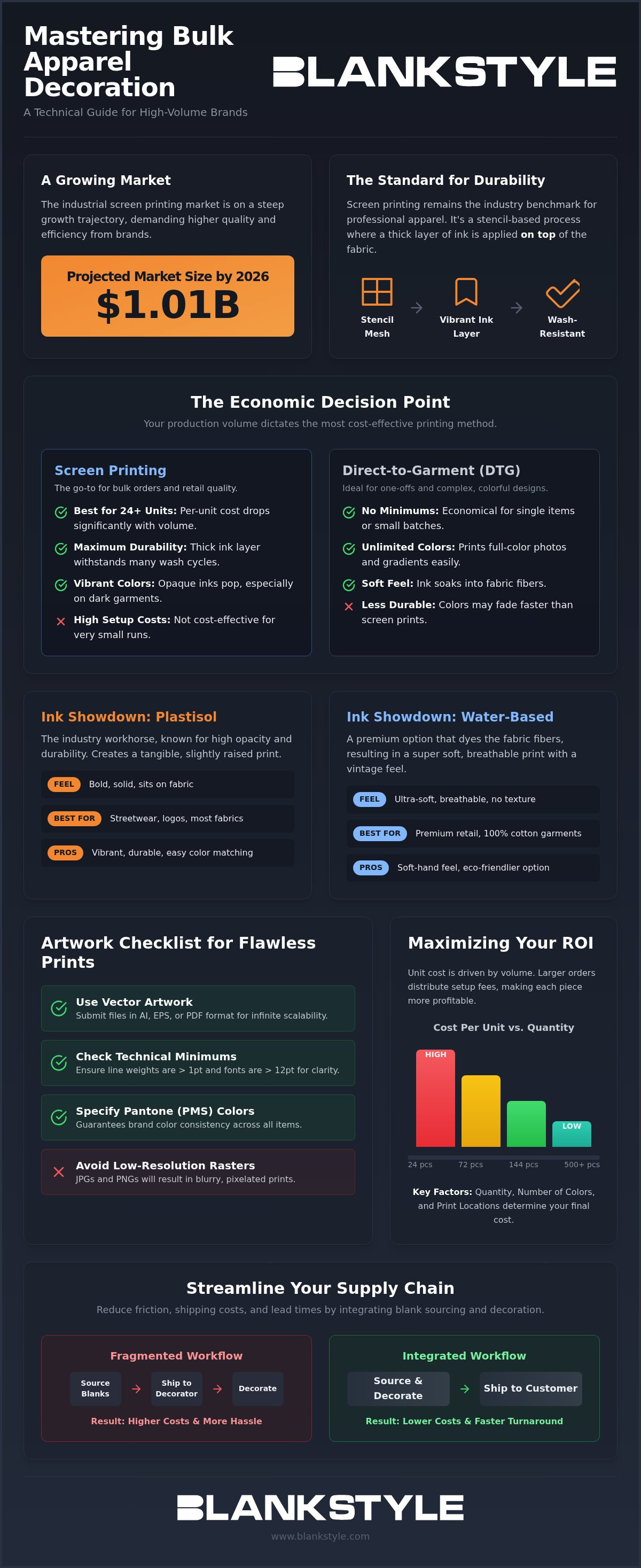
Professional screen printing is a stencil-based ink application process. The fundamentals of screen printing involve forcing ink through a tensioned mesh screen onto a garment. This method remains the industry standard for durability and color vibrancy because the ink sits in a thick, opaque layer on the fabric. Unlike digital methods that soak into the fibers, screen-printed designs maintain their integrity over time. For brands scaling their operations, utilizing professional custom screen printing services ensures that logos and graphics remain crisp after dozens of wash cycles.
The choice between screen printing and Direct-to-Garment (DTG) is an economic decision based on volume. Screen printing has high initial setup costs due to the labor required to create screens. However, the per-unit cost drops significantly as the order quantity increases. Most brands transition to screen printing once they reach orders of 24 units or more. Technical factors like mesh count also dictate the final result. Higher mesh counts allow for intricate, fine-line detail. Lower mesh counts deposit more ink, which is vital for heavyweight t-shirts to ensure the design doesn’t look thin or transparent.
The Anatomy of a Screen Print Order
Every color in your artwork requires a separate screen. A design with four colors requires four color separations and four individual screens. On dark garments, printers use a “flash” process. This involves heating an underbase layer of white ink before printing additional colors on top. This technique prevents the garment color from dulling the vibrancy of the ink. Because of the labor involved in press calibration and screen burning, a 12-piece minimum is standard for professional-grade setups. Smaller runs aren’t cost-effective for high-volume production schedules.
Plastisol vs. Water-Based Inks
Plastisol is the primary ink used by custom screen printing services. It’s durable, easy to pantone match, and provides the high opacity essential for streetwear brands like Shaka Wear. Water-based and discharge inks offer a “soft-hand” feel by soaking into the fabric fibers. Premium retail brands often prefer water-based inks for a breathable, vintage aesthetic. These inks work best on 100% cotton fabrics where the pigment can properly bond with the material without the risk of dye migration from synthetic fibers.
Technical Precision: Optimizing Artwork for Professional Printing
Professional results depend on the quality of the source file. Custom screen printing services require specific technical parameters to translate a digital image into a physical stencil. If the artwork is flawed, the final print will reflect those imperfections regardless of the quality of the printing press. Ensuring your files are print-ready is the first step toward a successful bulk production run.
Vector vs. Raster: Why File Type Matters
Vector art is the essential standard for high-volume screen printing because it allows for infinite scaling without losing edge definition. Unlike raster images, such as JPEGs or PNGs which rely on pixels, vector files use mathematical paths. When a low-resolution raster file is enlarged, it becomes pixelated and blurry, making it impossible to burn a crisp screen. To convert low-resolution images, designers must trace the paths to create a scalable AI, EPS, or PDF file. This ensures that every line remains sharp, whether it is printed on a pocket or a full back hit.
Managing complex designs requires an understanding of half-tones. These are patterns of small dots that vary in size to simulate gradients and shadows. High-mesh screens are necessary for these designs to prevent the dots from blurring together. For brand consistency, the Pantone Matching System (PMS) is the industry standard. It ensures your brand colors remain identical across different garments, whether you are printing on a Bella Canvas jersey or a thick sweatshirt.
Common artwork pitfalls include lines that are too thin to hold ink. Most professional shops require a minimum line weight of 1pt and a minimum font size of 12pt for legibility. If design elements are too small, the ink will bleed together, resulting in a closed or muddy appearance. Before finalizing your order, check your design for these technical constraints to avoid production delays.
Print Placement and Sizing Standards
Scaling artwork for a range of garment sizes is a logistical challenge. A design that looks perfect on a Large wholesale t-shirt might look too small on a 4XL or too large on an XS. Brands often create two sets of screens to maintain visual balance across the size run. Standard placements include center chest, left chest, and back hits. You must keep artwork within safe zones, avoiding seams, zippers, and collars where the printing surface is uneven. For those looking to start a new project, our instant quote tool can help you calculate costs based on your specific placement and color requirements.
Matching Blanks to Print Techniques: Fabric Compatibility
The success of custom screen printing services depends on the synergy between ink chemistry and fabric composition. Choosing the wrong blank can lead to poor ink adhesion, distorted graphics, or catastrophic dye migration. Professional apparel brands treat the garment as a technical foundation rather than a simple canvas. Understanding how different fibers react to heat and ink deposits is essential for maintaining retail-quality standards across high-volume orders.
100% cotton remains the gold standard for apparel decoration. Natural fibers provide superior ink adhesion and color clarity because the surface is porous and stable. When printing on polyester or performance fabrics, brands face the challenge of dye migration. This occurs when the garment’s synthetic dyes turn into gas during the heat curing process, bleeding into the screen-printed ink. To prevent a white print from turning pink on a red polyester shirt, printers must use specialized low-bleed inks and poly-blocker bases.
Fabric weight, measured in grams per square meter (GSM), also influences the final aesthetic. Heavy ink deposits, typical in streetwear designs, require a stable base to prevent the garment from sagging or puckering. Sourcing heavyweight t-shirts ensures the fabric has the structural integrity to support multi-color designs without compromising the drape of the shirt. Conversely, lightweight fashion tees are better suited for high-mesh counts and thinner ink layers.
Cotton, CVC, and Tri-Blends
- 100% Cotton: Ideal for vibrant, opaque plastisol prints. It withstands high curing temperatures without scorching.
- CVC (Chief Value Cotton): These blends are typically 60% cotton and 40% polyester. They offer a durable, cost-effective alternative that holds fine detail well while providing increased wrinkle resistance.
- Tri-Blends: Composed of cotton, polyester, and rayon. These fabrics are best for achieving a vintage, heathered look. They require thinner ink layers to maintain their signature soft feel.
Brand-Specific Performance
Different manufacturers engineer their fabrics for specific use cases. Sourcing from Gildan is a strategic choice for high-volume, cost-sensitive promotional runs where durability and value are the primary drivers. For brands targeting a premium retail market, Bella Canvas provides Airlume combed and ring-spun cotton that ensures a smooth printing surface with minimal stray fibers. If your brand prioritizes modern fits and a soft-hand feel, Next Level Apparel offers high-quality CVC and jersey fabrics that perform consistently under professional screen printing conditions. Selecting the right brand ensures your wholesale t-shirts align with your target price point and quality expectations.
Maximizing ROI: Pricing Factors and Bulk Ordering Strategies
Screen printing is a volume game. The economic efficiency of custom screen printing services relies on the inverse relationship between order quantity and unit price. High initial setup costs, including screen preparation and press calibration, are spread across more units as the order size grows. For apparel brands, managing the cost of goods sold (COGS) is vital for maintaining healthy profit margins. Sourcing wholesale blank t-shirts directly from your decorator is the most effective way to lower these costs by eliminating double shipping and administrative friction.
Variables like print locations and color counts directly impact your bottom line. Every additional print location, such as a sleeve hit or a back graphic, requires a separate set of screens and a new pass through the dryer. Similarly, the color count is a primary cost driver. A design with five colors requires five screens and five distinct ink setups. Simplifying your palette or using the garment color as a “negative space” element can significantly reduce production expenses without compromising the visual impact of your merchandise.
Understanding Setup and Screen Fees
Setup fees cover the technical labor required to prepare your project for the press. This includes creating film positives, coating screens with light-sensitive emulsion, and burning the images using UV light. Precise press calibration ensures that each color aligns perfectly, a process known as registration. You can maximize your ROI by reusing designs across different garment styles. A single set of screens can often be used for both hoodies and t-shirts if the artwork dimensions remain consistent. This strategy allows you to launch a multi-product collection without paying for duplicate setup labor.
Volume Tiers and Price Breaks
Professional print shops operate on tiered pricing structures where significant “price breaks” occur at specific quantities. Common sweet spots in wholesale ordering include 72, 144, and 500 units. To hit these higher tiers, brands should consolidate orders. You can often mix different garment colors of the same style to reach a higher volume break, provided the ink colors remain the same. If you’re planning a complex brand launch, integrating embroidery services for headwear or outerwear alongside your screen-printed goods can create a cohesive retail presence. Use our instant quote tool to forecast your project budget and identify the most profitable volume for your next run.
Streamlining Your Supply Chain with Integrated Logistics
Logistical efficiency is the backbone of a successful apparel brand. Sourcing blanks and decoration from separate vendors creates unnecessary friction. It increases shipping costs. It extends lead times. Using a single national provider for custom screen printing services eliminates these bottlenecks. This integrated approach removes the middleman between the wholesaler and the printer. It ensures quality control through a unified supply chain. From the initial garment selection to the final fold, every step happens under one roof. This minimizes the risk of errors. It ensures that the final product meets retail standards. A well-oiled supply chain is the difference between a profitable launch and a logistical nightmare. To further enhance your operational speed, find out more about how professional in-house label printing solutions can streamline your shipping and inventory management.
Modern e-commerce requires hands-off fulfillment solutions. High-turnover brands need to scale without the burden of warehouse overhead. Integrating custom screen printing into a drop-shipping model allows for seamless inventory management. You focus on design and marketing while the production hub handles the logistics. This model supports rapid growth from small batches to national distribution. Efficient fulfillment centers manage the transition effortlessly. It allows brands to maintain lean operations while meeting high consumer demand. Digital inventory tracking ensures you never miss a sales opportunity due to stockouts. Scaling your brand becomes a matter of digital coordination rather than physical labor. While managing your brand’s digital growth, ensure your physical headquarters reflects that same modern aesthetic with curated furniture and decor from elevenpast.
Reliability comes from industry experience and logistical competence. Founded in 2004, Blankstyle prioritizes business-to-business efficiency and stability. We provide access to a massive catalog of premium brands, including Comfort Colors and Independent Trading Co. This selection ensures you find the exact fit and fabric for your target audience. Our national logistics network offers free shipping on orders over $69. This reduces your total cost of goods sold. A 60-day return policy on blanks provides additional security for your inventory planning. We understand the technical requirements of high-volume decoration. Our team acts as a steady hand in a fast-moving industry. This level of professional support is essential for brands looking to dominate the apparel market. Get an instant quote for your custom screen printing project today and experience a more efficient supply chain.
Scaling Your Apparel Brand with Precision Logistics
Building a scalable apparel brand requires a shift from creative design to technical execution. Success depends on aligning your vector artwork with the correct fabric composition to ensure lasting durability. By mastering volume price breaks and consolidating your supply chain, you minimize production friction and maximize your profit margins. Professional custom screen printing services provide the consistency needed to compete in a crowded retail market, turning your vision into high-performance merchandise.
Efficiency is the primary driver of growth. Sourcing blanks and decoration from a single provider reduces lead times and eliminates double shipping costs. We offer wholesale pricing for everyone, ensuring your project stays within budget regardless of scale. Orders over $69 qualify for free shipping, and our 60-day return policy on blank apparel provides the flexibility your business needs to manage inventory with confidence. You have the tools and technical knowledge to move forward. Start your custom screen printing order with an instant quote today and take the next step in your brand’s evolution.
Frequently Asked Questions
What is the minimum order for custom screen printing services?
Professional custom screen printing services require a labor-intensive setup process. Most high-volume shops establish a 12-piece minimum to ensure cost-efficiency for the customer. Smaller runs are typically better suited for digital methods like DTG. For apparel brands, reaching higher volume tiers significantly reduces the unit cost of production. Use our instant quote tool to see how different quantities affect your project’s final bottom line and logistical planning.
How many colors can I include in my screen printed design?
You can include multiple colors, but each one requires a separate mesh screen and a distinct setup process. Most automatic presses can handle up to 10 or 12 colors per location. However, increasing the color count raises the total cost of custom screen printing services. Simplifying your palette or using the garment color as a negative space element helps maintain a high-impact design while keeping your production expenses manageable.
Can I screen print on different garment types in the same order?
Yes, you can mix different garment types like t-shirts and hoodies within a single order. This strategy allows you to hit higher volume price breaks across your entire inventory. The primary requirement is that the ink colors and design dimensions must remain identical across all items. If you change the artwork size to fit both a crop top and a heavyweight t-shirt, it will require a separate set of screens. To further expand your brand’s merchandise variety beyond standard printing, you can discover B-BAM! Inc. for their high-quality custom patch options.
Standard production times typically range from 7 to 14 business days after artwork approval. This timeline accounts for screen burning, press calibration, and final quality control checks. Factors like the complexity of the design and current seasonal volume can influence the schedule. We recommend planning your project well in advance of your launch date. Rush options are often available for brands operating on tighter national distribution deadlines.
Does the fabric type affect the quality of the screen print?
Fabric composition is a critical factor in print quality and garment durability. 100% cotton is the industry standard for vibrant results because the fibers bond effectively with the ink. Synthetic fabrics like polyester require low-bleed inks to prevent dye migration. Blends like CVC or tri-blends offer a softer feel but may result in a more heathered look. For materials that are difficult to print on directly, A1 Promotions Ltd. explains how custom patches can serve as a durable and professional branding alternative. Choosing the right blank ensures your design remains crisp through repeated washes.
Maximizing your ROI involves consolidating orders to reach higher volume price breaks. Focus on reducing the number of print locations and colors to minimize setup labor. Sourcing your wholesale blanks and decoration from a single provider also reduces shipping overhead. We offer free shipping on orders over $69, which significantly lowers your total cost of goods sold. Utilizing tiered pricing allows you to scale your brand more profitably.
Can I provide my own blanks for screen printing?
While some shops allow customers to provide their own garments, sourcing blanks directly through your decorator is more efficient. We maintain an extensive catalog of brands like Gildan and Bella Canvas, ensuring technical compatibility with our inks. Providing your own blanks often complicates the logistics and quality control process. Integrated sourcing ensures that any production errors are handled within a single, unified supply chain without unnecessary administrative friction.
How do I ensure my brand colors are matched exactly?
Maximizing your ROI involves consolidating orders to reach higher volume price breaks. Focus on reducing the number of print locations and colors to minimize setup labor. Sourcing your wholesale blanks and decoration from a single provider also reduces shipping overhead. We offer free shipping on orders over $69, which significantly lowers your total cost of goods sold. For those looking to further optimize their local fulfillment and inventory tracking, check out DuraFast Label Company Canada. Utilizing tiered pricing allows you to scale your brand more profitably. Before placing your first large-scale order, review our professional step-by-step framework for ordering bulk custom shirts to avoid common pitfalls and protect your production budget.