
Most bulk apparel orders fail not because of the design, but because of a breakdown in technical logistics. You want a high-quality finished product, yet the process of ordering bulk custom shirts often feels like a minefield of hidden shipping fees and prints that peel after two washes. It’s frustrating to invest your budget only to receive heavyweight t-shirts that shrink or crop tops that don’t fit your brand’s standards. You need a reliable workflow that eliminates these common pitfalls and protects your bottom line. Whether you are a service provider or a specialty retailer like Chickhuber Coffee, professional-grade apparel is a key component of your physical brand presence.
You’re right to be cautious about the technical details. A successful order requires more than just uploading a logo; it demands a synchronized approach where garment selection and decoration methods align perfectly. This guide provides a professional framework to help you master the logistical process, ensuring you maximize quality while minimizing costs. We’ll walk through choosing the right blanks, navigating tiered wholesale pricing, and selecting the best decoration techniques to ensure your apparel is retail-ready upon arrival.
Key Takeaways
- Select the right blank garment as your foundation, focusing on fabric weight and construction to ensure long-term durability and retail value.
- Match your decoration method to the fabric; use screen printing for high-volume graphics or embroidery for premium, long-lasting branding.
- Optimize your budget for bulk custom shirts by utilizing tiered wholesale pricing and strategic price breaks at specific volume levels.
- Streamline your logistical workflow by using professional quote tools to establish a clear baseline budget before production begins.
- Eliminate middleman markups by sourcing both your blank apparel and custom decoration services from a single, integrated provider.
Selecting the Foundation: Choosing the Best Blank Apparel for Bulk Customization
The blank garment is the canvas for your project. Its quality dictates the final product’s perceived value and longevity. If you start with a low-quality base, even the most intricate design will look cheap. Professional buyers view the blank as a structural component rather than a simple commodity. The fabric’s physical properties determine how the ink adheres, how the garment drapes, and how it survives the laundry cycle.
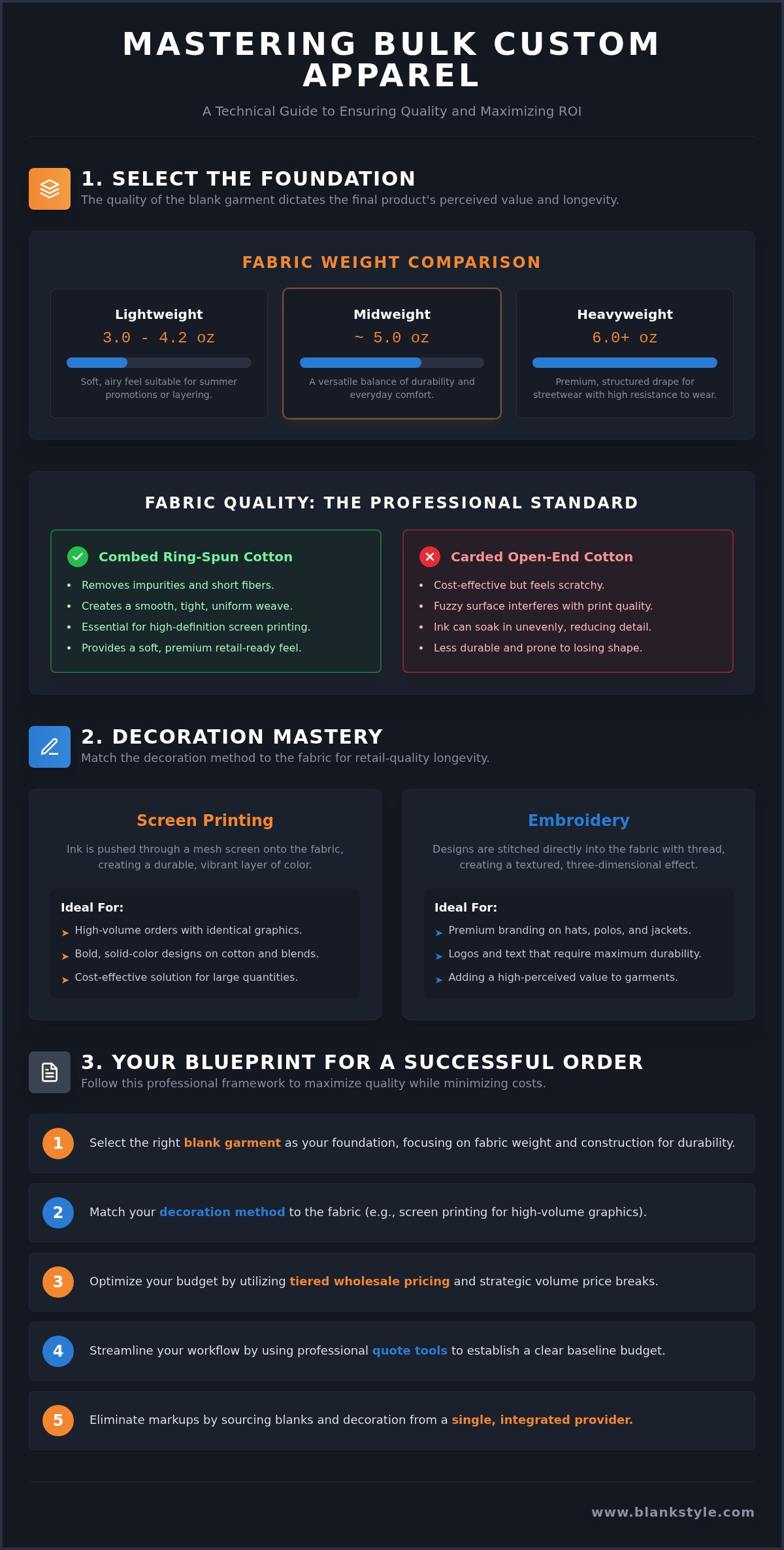
Fabric weight is a primary technical specification. It is typically measured in ounces per square yard or GSM (grams per square meter). Lightweight fabrics, ranging from 3.0 to 4.2 oz, provide a soft, airy feel suitable for summer promotions or layering. Midweight options around 5.0 oz offer a balance of durability and comfort. For a premium streetwear aesthetic, heavyweight t-shirts (6.0 oz and up) provide a structured drape and high resistance to wear. These heavier options often command a higher retail price point because they feel substantial to the end-user.
The refinement of the cotton fiber is equally critical. Carded open-end cotton is cost-effective but feels scratchy and has a fuzzy surface that can interfere with print quality. Combed ring-spun cotton is the professional standard. It undergoes a process that removes short fibers and impurities, resulting in a smooth, tight weave. This smooth surface is essential for high-definition screen printing, as it allows the ink to sit evenly on the fabric rather than soaking into loose, uneven fibers. Utilizing retail-ready brands like Bella + Canvas or Next Level Apparel ensures your bulk custom shirts meet modern consumer expectations for softness and consistency.
Fabric Composition: Cotton, Polyester, and Blends
100% cotton remains the industry gold standard for breathability and traditional ink absorption. It works seamlessly with most printing methods. Polyester and performance blends are engineered for moisture-wicking and athletic use. These fabrics require specialized inks and temperature controls to prevent dye migration, which is when the garment’s color bleeds into the print. CVC (Chief Value Cotton) and Tri-blends offer a “heathered” or vintage appearance. These fabrics provide superior softness and a slight stretch, making them ideal for lifestyle brands that prioritize a premium hand-feel and comfortable fit.
Fit and Style Considerations for Volume Orders
Choosing the right silhouette is a logistical decision. Unisex fits provide broad appeal and simplify sizing for large events. Fashion fits are more tailored, featuring side-seams that prevent the shirt from twisting or losing its shape after washing. You can differentiate your merchandise by incorporating specialty cuts like crop tops for a modern, trend-focused aesthetic. When planning your bulk custom shirts order, a standard “bell curve” distribution is a reliable baseline, though you should adjust based on your specific demographic data to avoid leftover inventory in extreme sizes.
Decoration Mastery: Comparing Screen Printing and Embroidery for Bulk Orders
Choosing the right decoration method for bulk custom shirts is a technical decision based on the garment’s fabric and its intended lifespan. Professional decoration ensures longevity that DIY or low-end transfers cannot match. High-quality prints or stitches should withstand dozens of industrial washes without significant degradation. Before full production begins, the process includes digital proofs or strike-offs. These samples allow you to verify color accuracy and placement against your original artwork. For a deep technical dive into specific printing techniques, consult our Custom Screen Printing Services Pillar.
The decoration method must align with the substrate. For instance, a lightweight cotton tee reacts differently to ink than a polyester performance blend. Selecting the wrong method can lead to issues like dye migration on synthetics or puckering on thin knits. You must also consider legal compliance for finished goods. When preparing your designs for resale, ensure you follow labeling requirements for apparel to maintain industry standards. This transparency builds trust with your end-users and ensures your brand meets federal guidelines for fiber content and care instructions.
A professional partner helps navigate these variables to ensure the final product matches your vision and budget. By understanding the mechanical differences between ink and thread, you can make informed choices that enhance the durability of your apparel.
Screen Printing: The High-Volume Standard
Screen printing remains the high-volume industry standard. The process involves pushing ink through a fine mesh screen directly onto the fabric, creating vibrant, opaque designs. Cost is primarily driven by color count and setup fees. Each color requires a separate screen; therefore, multi-color designs incur higher initial costs. Choosing between Plastisol and water-based inks allows you to prioritize either color opacity or a soft, breathable hand-feel for your bulk custom shirts.
Custom Embroidery: Adding Premium Texture
Custom embroidery adds a premium, three-dimensional texture to structured items like hats or hoodies. It requires digitizing, which converts vector artwork into a machine-readable stitch file. Embroidery is exceptionally durable, often outlasting the garment itself, making it ideal for corporate workwear. It provides a professional aesthetic that increases the perceived value of the merchandise.
You can compare decoration options using our instant quote tool to see how each method impacts your per-unit cost.
Maximizing ROI: Understanding Wholesale Tiered Pricing and Logistics
Return on investment in apparel isn’t solely about finding the lowest price per item. It’s about managing the total landed cost. When you order bulk custom shirts, you’ll encounter the “Price Break” concept. These are specific volume thresholds where the cost per unit drops significantly. It’s a common industry occurrence where ordering 72 units actually results in a lower total bill than ordering 50 units because you’ve moved into a more favorable discount tier. Understanding these breaks allows you to scale your order to maximize value without overextending your budget.
The final per-unit price is a combination of the blank garment cost and the decoration cost. Balancing these two factors is essential for maintaining your margins. Sourcing both the blanks and the decoration from a single provider eliminates middleman markups that often inflate costs. To master these financial strategies, check The Ultimate Guide to Sourcing Wholesale Blank T-Shirts in 2026 for detailed pricing insights.
Decoding Tiered Pricing Structures
Industry standards typically set major price breaks at 12, 36, 72, and 144 units. Beyond these quantities, you often transition from “piece pricing” to “case pricing.” Ordering in full manufacturer increments reduces labor in the warehouse, and those savings are passed to you. You must also account for technical fees that can impact your ROI. These include screen setup fees, digitizing fees for embroidery files, and flash charges for printing light colors on dark fabrics. The American Screen Printing Association provides resources that help professionals understand these technical standards to avoid unexpected expenses during the billing process.
Logistics and Lead Times for National Shipping
Efficient logistics are just as important as the price per shirt. You need to distinguish between production time and transit time. Production covers the days spent in the shop, while transit is the time your order spends with the carrier. Planning your project timeline at least 14 days in advance helps you avoid expensive rush fees. Choosing stocked brands like Gildan ensures faster fulfillment because the inventory is readily available. Overhead is further reduced by utilizing Blankstyle’s free shipping on orders over $69. For brands looking to scale without warehouse costs, drop-shipping solutions can move bulk product directly to your retail locations or end customers.
Step-by-Step: How to Place a Bulk Custom Shirt Order
Ordering bulk custom shirts is a technical operation that demands a structured workflow. Managing a large-scale project requires more than a simple transaction; it involves precise coordination between design specifications and manufacturing capabilities. Utilizing an instant quote tool establishes your baseline budget early in the process. This transparency prevents cost overruns and allows you to adjust garment choices or decoration methods before committing funds. While automated tools provide speed, customer service representatives play a vital role in finalizing technical production details, such as ink density or stitch counts. A 60-day return policy on blank apparel serves as a professional safety net, ensuring you only pay for quality that meets your standards. For businesses that value this level of craftsmanship in their own offerings, you can discover Blackhand Coffee Co and their commitment to excellence for coffee connoisseurs.
Successful production begins with the file type. Screen printing requires vector files, typically in .AI or .EPS formats, because they can be scaled infinitely without losing resolution. Raster files, like JPEGs, often result in jagged edges or blurry prints. Print-Ready Artwork consists of high-resolution vector files with outlined fonts to ensure text renders correctly across different systems. Sourcing the right garment is equally important for brand alignment. You can match your budget and aesthetic to specific brands, such as Comfort Colors for a garment-dyed, lived-in feel, or Shaka Wear for an ultra-heavyweight streetwear silhouette. Choosing the right base ensures the final print looks as intended.
Phase 2: Quoting, Proofing, and Production
The next stage involves balancing costs through the instant quote tool. This allows you to compare different garment and decoration combinations in real-time. Once the order is initiated, the digital proof is your most critical checkpoint. Review this document carefully for placement, print dimensions, and color accuracy. Giving the “green light” on a proof is a binding step in the production cycle. During the actual run, professional decorators implement final quality control measures to verify consistency across a 500-unit run. This ensures the first shirt matches the last in terms of ink opacity and placement. This methodical approach guarantees that your bulk custom shirts arrive exactly as specified.
Ready to start your project? Get an instant quote to establish your production budget today.
Scaling Your Brand with Blankstyle’s Custom Solutions
Scale is a logistical challenge that requires a transition from one-off projects to a sustainable supply chain. Blankstyle functions as a long-term partner for corporate entities and emerging apparel brands. With industry experience dating back to our founding in 2004, we provide the stability needed to manage high-volume production. This allows you to focus on design and marketing while we handle the technical complexities of manufacturing and fulfillment. Our goal is to make the process of ordering bulk custom shirts as predictable and efficient as possible. If you are also looking to expand your brand with high-quality custom pins, read more about how to select the best options for your logo.
Growth often involves moving beyond the standard tee. Diversifying your inventory with sweatshirts or bags increases your brand’s utility for the end-user. Seasonal shifts are the perfect time to introduce hoodies and hats. For those targeting specific niches, kids’ t-shirts offer a way to reach family-oriented markets. Premium brands often select Independent Trading Co for their superior fleece construction, which provides a high-end feel that justifies a premium price point. Expanding your catalog allows you to maximize your reach without finding a new supplier for every product category.
The Blankstyle Advantage: Reliability at Scale
Reliability is the foundation of scale. Our no-nonsense logistics facilitate efficient delivery across the nation, ensuring your bulk custom shirts arrive on schedule. We offer pragmatic support that addresses the needs of both seasoned professionals and those scaling their first youth brand. Centralizing your blank sourcing and custom decoration eliminates middleman markups and simplifies your project management. This efficiency is supported by our 60-day return policy and free shipping on orders over $69, which helps you maintain tight control over your operational overhead. You get the benefits of a large-scale operation while maintaining the individual service required for specific brand projects.
The right partnership turns a complicated process into a repeatable success. Establishing your budget is the first step toward professional-grade apparel. Get an instant quote for bulk custom shirts and start your next project today.
Optimizing Your Custom Apparel Strategy
Successful procurement relies on a synchronized approach to garment selection and decoration logistics. You now have the professional framework to choose high-quality blanks, select the most durable decoration methods, and utilize tiered pricing to protect your bottom line. Ordering bulk custom shirts shouldn’t be a process of trial and error; it’s a technical operation that results in retail-ready merchandise. By aligning your brand’s aesthetic with the right fabric weights and print techniques, you ensure a consistent finished product that meets consumer expectations.
Blankstyle has been a trusted wholesale supplier since 2004, providing the logistical competence needed for large-scale apparel projects. We support your growth with free shipping on orders over $69 and an industry-leading 60-day return policy on blanks. This stability allows you to scale your brand with confidence and precision. Get an Instant Quote on Bulk Custom Shirts and take the first step toward a more efficient, professional supply chain. Your next project is ready for a steady hand and expert execution.
Frequently Asked Questions
What is the minimum order quantity for bulk custom shirts?
Minimums vary based on the specific decoration service. While blank apparel often has no strict minimum, custom screen printing typically requires at least 12 to 24 units to offset setup costs. Embroidery minimums can be lower depending on the project complexity. Utilizing tiered pricing ensures you get the best value as your volume increases. Check the instant quote tool for specific minimums on your chosen garment.
Which file format is best for screen printing artwork?
Vector files are the professional standard for screen printing. Formats such as .AI, .EPS, or high-resolution .PDF allow for infinite scaling without loss of clarity. These files ensure your logo has crisp edges and accurate color separation. Avoid using raster images like JPEGs or PNGs for bulk custom shirts, as these often result in blurry or pixelated prints that fail to meet retail quality standards.
How long does it typically take to receive a bulk custom order?
Standard production and delivery for bulk orders typically takes between 8 and 14 days. This timeline includes the period for artwork approval, garment sourcing, and the physical decoration process. Transit time varies based on your national location relative to the shipping hub. It’s best to plan your project at least two weeks in advance to ensure on-time delivery and to avoid expensive rush fees for urgent deadlines.
Can I mix and match shirt sizes and colors within a bulk order?
You can mix and match different shirt sizes within a single bulk order to accommodate your entire group. Mixing garment colors is also possible as long as the ink color and design remain consistent across the run. If you need to change ink colors, such as white ink on black shirts and black ink on white shirts, a color change fee may apply. This flexibility helps you meet diverse audience needs while maintaining wholesale pricing. For those planning coordinated group outfits, click here to see how Adorb Custom Tees utilizes these options for their matching collections.
Screen printing is the superior choice for bulk custom shirts due to its durability and cost-efficiency at scale. It utilizes thick plastisol or water-based inks that bond deeply with the fabric. Direct-to-Garment (DTG) is better suited for small, one-off orders with complex photographic details. For orders over 24 units, screen printing provides a more vibrant finish and a much lower per-unit cost than digital alternatives.
Does Blankstyle offer free shipping on bulk decorated orders?
Free shipping is available on all orders over $69, including bulk decorated apparel. This policy helps reduce the total landed cost of your project by eliminating standard ground freight charges. Since most bulk orders easily exceed this threshold, you can count on significant logistical savings. This benefit applies to our entire national service area, ensuring that your budget goes toward garment quality rather than shipping overhead.
What should I do if I need a sample before placing a large bulk order?
We recommend ordering a single blank garment to verify the fit, fabric weight, and color before committing to a full production run. This is the most efficient way to ensure the base shirt meets your brand standards. Blankstyle offers a 60-day return policy on blank items, providing a risk-free way to test different styles. For the decoration itself, you’ll receive a digital proof to confirm placement and sizing before printing begins.
Are there extra fees for oversized shirts (2XL+) in bulk orders?
Most apparel manufacturers apply a slight upcharge for oversized garments, typically starting at 2XL and increasing for larger sizes. These plus-size fees reflect the additional fabric and specialized handling required during the manufacturing process. These costs are passed through at the wholesale level. When using the instant quote tool, ensure you enter the specific quantity of each size to see an accurate total that includes these standard industry adjustments.